Results
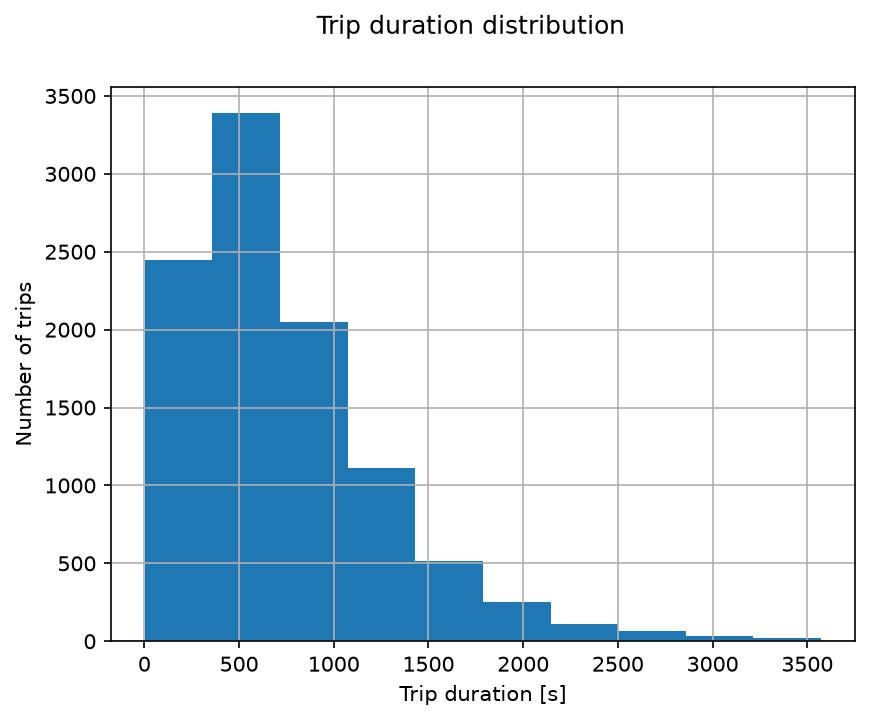
Trip duration is right-skewed: most trips take under 1,000 seconds (about 16 minutes), with a small tail of longer trips.
Across the three feature-engineering stages, R² went from 0.757 (basic trip attributes plus a simple weekend flag) to 0.808 (adding minute/hour/day/week/month features) to 0.799 (adding neighborhood-level aggregations on top). Interestingly, the richest feature set didn't perform best — the extra aggregation features added complexity without a clear payoff, a useful reminder that automated feature engineering doesn't guarantee improvement past a certain point.
The final model's predicted duration distribution closely mirrors the real one, and trip_distance dominates feature importance by far (0.867), followed by dropoff location and pickup hour, matching intuition: distance drives duration, location affects route/congestion, and hour affects traffic.
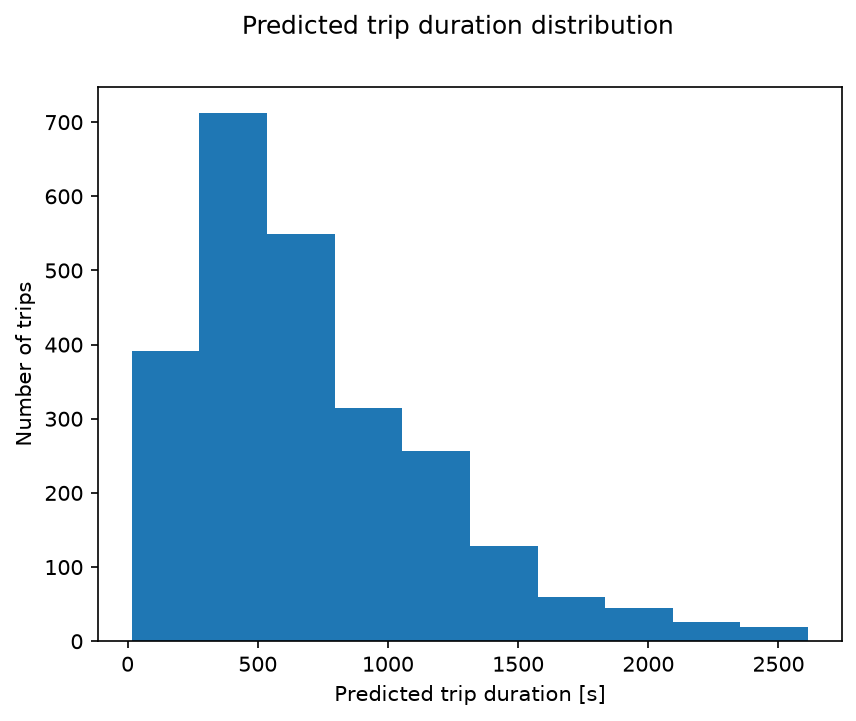
Predicted trip durations on the test set, closely tracking the shape of the real distribution above.